

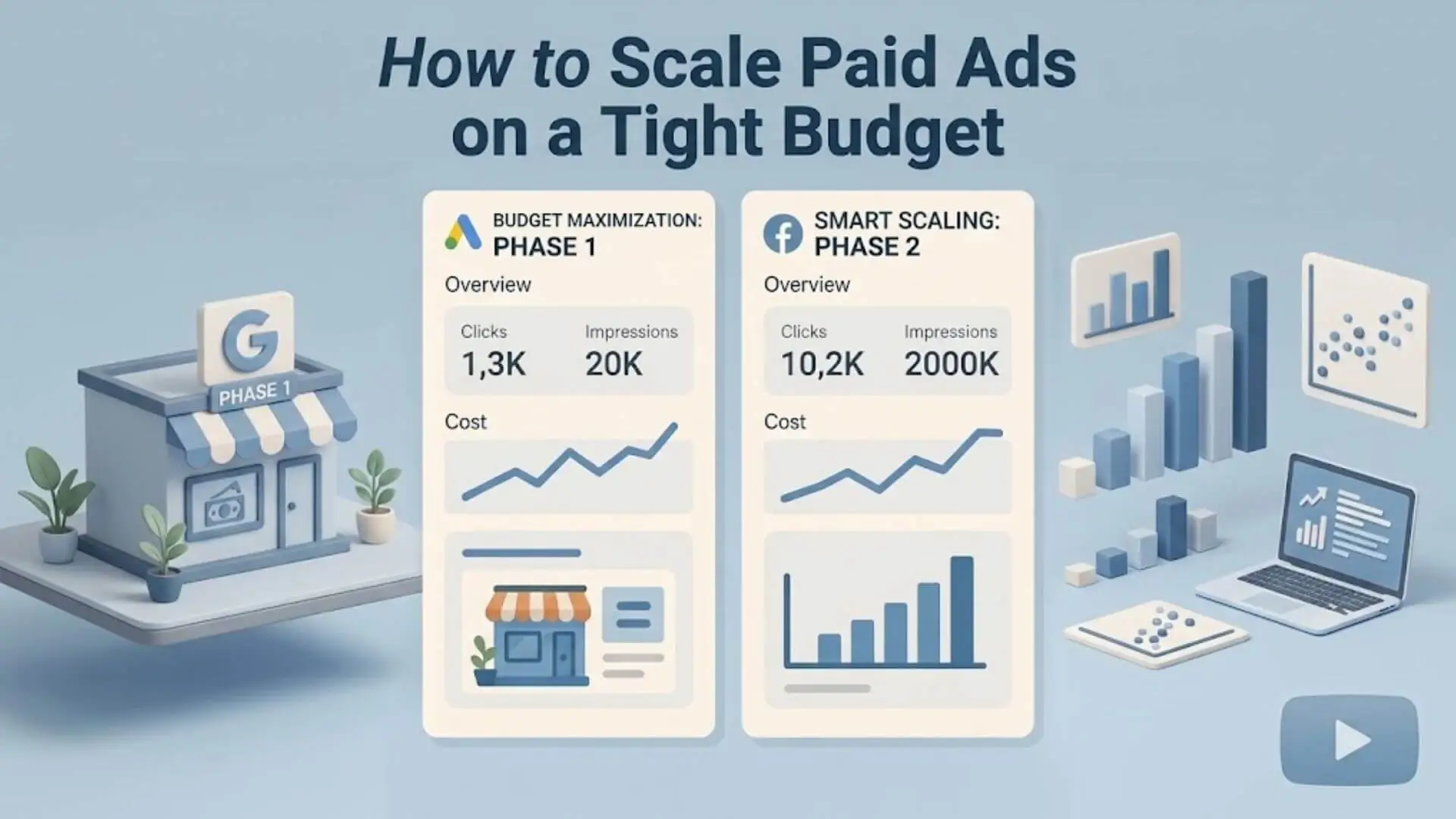
If you want to waste money fast, act like your tiny marketing budget is actually huge. It happens all the time, especially with startup founders trying to get traction. Many founders and marketers trying to scale paid ads on a tight budget fall into the dangerous trap of looking at massive brands running omnichannel campaigns and thinking you need to copy their playbook. You assume that if you throw a bit of money at Facebook or TikTok, boost an Instagram post, and try out Google Search, the sheer volume of activity will magically generate customers.
But instead, what do you get? A pile of empty likes, no real sales, and three weeks later you’re out of money, and conclude that paid ads simply don’t work for your business.
Actually, paid ads do work even on a small budget. You need a completely different approach when your capital is limited. Sometimes the problem isn’t that you don’t have enough money. It’s the way you’re spending what you have. Here’s how to scale paid ads on a tight budget, stretch your ad spend, and execute smart ad campaigns without wasting money.
What Does It Mean to Scale Paid Ads?
True ad scaling means increasing your sales or leads at a rate faster than or equal to your increase in ad expenditure. Scaling paid advertising is not as simple as logging into Meta or Google Ads and pumping your daily spend from $20 to $200 and crossing your fingers. If you’re pouring money into an already leaky sales funnel, you’ll lose faster.
If you have $5,000 to spend. You could put the entire amount behind one carefully tested campaign. Or divide it across five platforms, three audiences, six creatives, and four different offers. The second option sounds ambitious. It can also be a disaster. Why? Because in reality, you end up with crumbs everywhere and not enough data on any single channel to know what worked or didn’t. You’d have spread yourself so thin with barely enough data to learn what is driving results. You can’t confidently say which audience, message, or platform brought in customers.
10 Methods to Scale Paid Ads on a Tight Budget
When you are operating with a tight budget, the goal isn’t to spend more. It is to learn faster. Every penny you spend has one job: buying you clear, definitive answers about your market. Scaling paid advertising for startups is about learning what makes the right customer pay attention, click, enquire, and eventually buy. Once you know what works, then you scale.
1. Start With a Paid Advertising Strategy Before Increasing Your Budget
When scaling paid advertising, jumping straight into ad creation without a strategy is the fastest way to haemorrhage capital. As a startup, your initial paid campaigns are not about buying traffic but getting data. Your first campaigns should help answer critical business questions:
- Who actually buys?
- What message gets their attention?
- What offer gets them to act?
- What creative gets the click?
- What happens after the click?
2. Pick the Right Platform for Your Startup
Choosing one platform can be infinitely smarter than trying to be everywhere at once. Not all ad platforms are created equal, especially when your capital is limited. Instead of spreading yourself thin, pick a single advertising channel based on these realities:
- Where do your customers already spend their time? ((B2B? LinkedIn. Visual products? Instagram or TikTok.)
- Does your product need demonstration? (If people need to see it live, video platforms win over text-heavy search.)
- Are customers actively searching for a solution right now? (If yes, capture that high intent on Google Ads.)
- What is your available budget? (Some platforms require higher testing thresholds than others.)
Early-stage businesses are often advised to pick one channel. Then they master it and squeeze every drop of ROI out of it before diversifying across multiple platforms.
3. Stop Changing Five Things at Once
Nothing kills a startup campaign faster than impatient tinkering. Consider this common cycle:
- Monday: Change the target audience because clicks are slow.
- Tuesday: Change the ad creative because you got bored of looking at it.
- Wednesday: Bump the budget up because you saw two conversions.
- Thursday: Change the landing page headline.
- Friday: Conclude that paid advertising doesn’t work.
If you change five variables simultaneously, you will never know which one caused the result. Testing requires discipline. Let your ads run until you have enough data for an informed decision.
4. Retarget People Who Didn’t Convert
Most people will not buy or sign up on their very first visit to your website. They get distracted, or maybe they want to compare alternatives. Startups often obsess over chasing cold, brand-new audiences while completely ignoring the goldmine sitting right in front of them:
- Recent website visitors.
- Instagram and Facebook engagers.
- People who watched 50% of your video ads.
- Previous customers who haven’t reordered.
- People who added an item to their cart and abandoned checkout.
These people have already raised their hand and shown interest. That is why retargeting is such a powerful component for startups to scale paid ads on a tight budget. Retargeting ads cost a fraction of cold prospecting ads because you are talking to a warm audience that needs a gentle nudge to complete the goal.
5. Use Your Best-Performing Ads to Find New Opportunities
Once you find an ad creative or audience segment that outperforms the rest, don’t sit back. Dissect why it worked.
Did the hook about saving time resonate more than the hook about saving money? Take that winning angle and spin up three new variations of it. Did a specific customer segment convert at twice the rate of others? Build lookalike audiences based on those high-value buyers to expand your reach safely. If you discover a winning founder-led video or a high-performing graphic, don’t let it sit there. Spin it out into variations. When scaling paid advertising without increasing budget, simply extract maximum mileage from creative angles that have already proven they work.
6. Know Your Numbers Before You Scale Your Ads
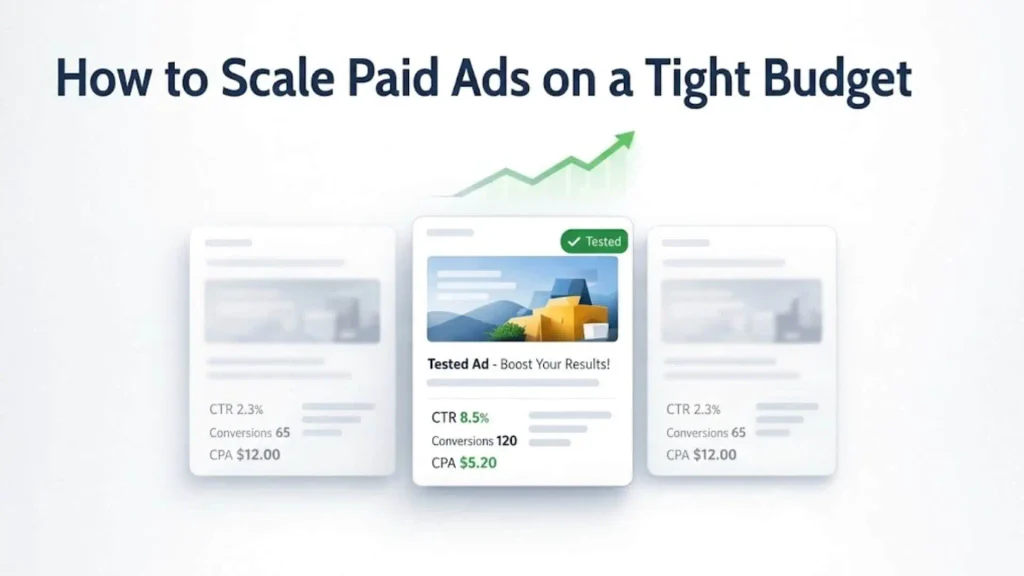
If you don’t know your core metrics, you are flying blind. You don’t need a degree in corporate finance to understand your unit economics, but you do need to answer one crucial founder question: “How much can I afford to spend to acquire one customer?” Keep your eye on your core metrics in relation to that question:
- Cost Per Click.
- Cost Per Lead.
- Cost Per Acquisition.
- Conversion Rate.
- Return on Ad Spend.
- Customer Acquisition Cost.
7. Use Organic Marketing to Support Your Paid Ads
Paid advertising shouldn’t exist in a vacuum. If you rely 100% on paid ads, your customer acquisition drops the second you pause it. Paid advertising buys attention, but organic channels like SEO, content, email, and social keep people engaged.
At Root and Rank Digital, we encourage startups to blend their paid media efforts with long-term organic engines. Your goal as a startup founder isn’t to stay on a permanent paid-acquisition treadmill forever. Paid ads help you figure out what messages land. Use that info for blog posts, email, or social, so you keep the momentum going.
8. Optimise Your Landing Page for More Conversions
Sending ad traffic to your cluttered homepage is a waste. If your ad says “Sort logistics in minutes,” the landing page should follow up on that message. It should not greet the visitor with a generic corporate header saying, “Welcome to XYZ Technologies.” The moment someone clicks your ad, they should feel an immediate sense of continuity. A paid ad clicker wants focus. They should never have to stop and wonder, “Did I click the wrong link?” Make sure the landing page matches what your ad promised. Use reviews, testimonials, case studies, and keep forms simple so people don’t bounce before signing up.
9. Start Small and Test Your Paid Ads
When you are learning to grow paid ads without increasing budget, testing is your best friend. You don’t need a $5,000 monthly testing budget to find what works. Run small, controlled experiments by varying one element at a time. Try two completely different audiences. Test images against videos, short against long, features against benefits. And give each test enough time. Let your tests run until you have statistically significant data. Otherwise, you are guessing.
10. Refresh Your Ad Creative Before Increasing Your Budget
Ad fatigue is real. If you run the same image and headline to the same audience for too long, your ads will get stale. You can try:
- Founder Stories
- Product Demonstrations
- Educational Carousels
- User-Generated Content (UGC)
When your ad creative is relatable, your ad spend will stretch significantly further.
At the end of the day, the winner isn’t the business that spends the most. It’s the team that learns fastest and adapts every single time they spend.
And if you’re tired of burning cash on tactics that never stick, why not ask for help? Root and Rank Digital specialises in helping early-stage founders build airtight growth and paid advertising strategies that scale sustainably.
Get in touch with the team at Root and Rank Digital today, and let’s build your custom growth roadmap.
