
A lot of startup founders fall into the trap of thinking that hiring a top-tier designer or a premium website template automatically brings in users. Good design isn’t the same thing as good SEO. You can have a stunning site and still end up buried in search results. Startup website SEO strategies require looking beneath the surface and aligning your backend signals with your frontend presentation. There are on-page SEO strategies every website needs to be inculcated; otherwise, the product will flop.
You can build an amazing product and obsess over the user experience, but if no one ever finds your site, none of that matters. Google isn’t impressed by your design taste. It cares about clarity and structure. Search engines are trying to match queries to the best possible answers, so your website needs to communicate exactly what you offer and which pages solve which problems. On top of that, when real people land on your site, they should right away know what you do and what they’re supposed to do next.
See it from this perspective. Design gets people interested while structure helps them understand. SEO helps them find you in the first place. That is why one of the first on-page SEO strategies every website needs is to consider optimisation while you’re building the website, not six months after launch.
That’s where we come in at Root and Rank Digital. We work with founders, early-stage or well-established, who are pouring themselves into their products and don’t want to lose sleep over flat traffic and search invisibility. We don’t hand you a 300-page SEO manual and wish you luck. We guide you, hands-on, through high-impact on-page SEO strategies that actually help you grow.
But to start, let’s break it all down.
What Is On-Page SEO?
Before we jump to it, it helps to know what you’re actually working with. SEO boils down to three major parts: Off-Page SEO, Technical SEO, and On-Page SEO.
On-Page SEO is everything your visitors see, from copywriting, HTML tags, headings, images, internal links, to the entire user experience.
Top 10 On-Page SEO Strategies Every Website Needs
To make this actionable, here’s our proven framework for getting startups noticed in search results (and keeping them there):
1. Always Start with Keyword Research
Effective SEO starts here. If you don’t know what your customers are typing into Google, you’re just guessing. Don’t chase big, crowded search terms like “CRM” or “shoes”. Zero in on longer, more specific searches that match what you offer, with less competition.
Work those keywords naturally. Put them in your page titles, headers, and first paragraphs. Never force a keyword where it doesn’t belong. Google’s algorithms are smart enough to spot robotic keyword stuffing instantly.
2. Start Listening to People’s Search Intent
SEO starts with a surprisingly simple question: What are your customers actually searching for? Not what you call your product. Not what your team calls it internally. But what your potential customer types into Google when they need solutions. You also have to understand why someone is searching for it. It is essentially customer research. It is the art of listening in on the exact questions your target audience is asking when they have a problem your startup solves. Start with conversations. What questions do customers ask before buying? What problems do they describe? What do they compare? What would they type into Google if they didn’t know your brand existed?
There are four types of search intent:
- Informational (“what is a conversion funnel”)
- Navigational (“Root and Rank Digital login”)
- Commercial (“best email marketing tools compared”)
- Transactional (“buy premium leather laptop bag”)
Know which intent matches your pages. There is no on-page SEO with search intent.
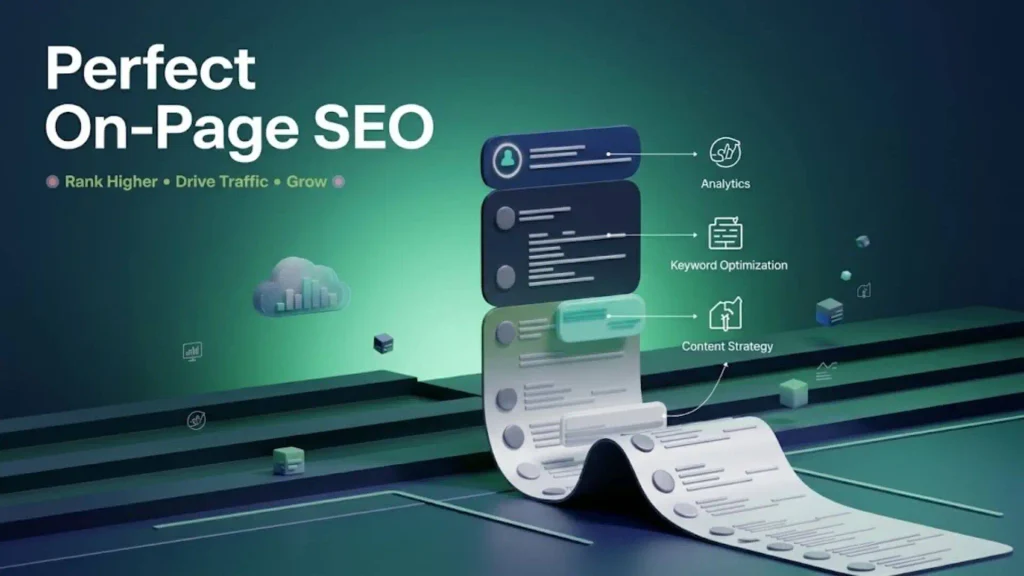
3. Give Every Important Page One Job
Founders love cramming everything onto the homepage: their story, product details, every blog, newsletter signup, and more. Stop. A stronger approach is to give every important page one job:
- Homepage: Introduce the business. Point visitors where they need to go.
- Product/Service Page: Convince and convert.
- Blog: Build trust and personality.
- About Page: Build human trust and share your brand story.
- FAQ Page: Remove final objections and friction.
If you’re trying to make one page rank for “fintech,” “finance,” “money company,” “financial agency,” and 20 unrelated searches, you’re probably creating a page that’s useful for none of them. One page. One primary purpose. One clear audience. That doesn’t mean your pages can only rank for one keyword. Nail down exactly what each page is for and who it’s talking to.
4. Work on Your Page Titles and Meta Descriptions
Your page title is more than an SEO checkbox. It’s often the first thing someone sees when your page appears in search. If they are boring, nobody is going to click. Too many founders treat title tags as an afterthought, either stuffing them with random brand names or leaving them generic.
A great title does two things: It signals to Google what the page is really about (using clear, relevant keywords). And it gives people a reason to click. Compare a weak title like “Home – Kiksi” to a strong title like “Handmade Minimalist Leather Bags | Kiksi.” The second option instantly tells both the search engine and the human reader what the page offers, driving significantly higher click-through rates.
5. Create SEO-Friendly URLs
Your URLs should speak for themselves. They help both users and search engines figure out where they are before they even see your page. Keep them short, relevant, and free of random numbers. They act as an immediate anchor for search crawlers. Clean URLs like yoursite.com/startup-website-seo-strategies work far better than yoursite.com/p?id=8942-blog-post-final-v2.
6. Break Up Your Content With SEO Headings
Walls of text are the ultimate conversion killers. When people land on your page, they scan. If it’s hard for humans, it’s hard for search engines, too. Use headings to guide everyone, both people and robots. Set up a clear H1, then logical H2s and H3s. Messy navigation, missing anchor text, or confusing page structures just lose folks.
7. Write for People First, Search Engines Second
Here’s the golden rule: write for actual people, not for algorithms. Google is getting better at sniffing out thin, generic, or gimmicky content created just to grab rankings. You need genuine insights and your unique voice. Provide information that helps people. How long should your pages be? Long enough to fully answer the user’s query. If a topic requires a 2,000-word comprehensive guide, don’t truncate it into a 300-word summary.
8. Remember to Optimise Your Web Images
Startups love using high-resolution product photography and team snapshots. However, those can wreck your site speed if you’re not careful. Compress your files, go for WebP format, and write real alt text. Why? It helps visually impaired users, plus Google can actually understand what your image is supposed to show. Avoid uploading files named IMG_4920_final_v2.jpg. Make them descriptive, like olive-green-leather-tote.jpg. A beautiful 8MB photograph isn’t doing your business much good if the user gives up waiting for it to appear. If there is any of the on-page SEO strategies you shouldn’t miss, it is image optimisation.
9. Make Your Site Mobile-Friendly
In global markets, people are browsing on their phones. If your website looks good on a large desktop monitor but breaks or loads awkwardly on a smartphone, your rankings and conversions will suffer. Don’t just check a box that says “mobile-friendly.” Grab an actual phone, load your site, and see for yourself: are buttons easy to tap? Is everything readable? Does the design adapt cleanly? The best on-page SEO strategies for startup websites consider the entire experience, not just what Google sees.
10. Build Links Between Your Pages
On-page SEO also includes internal linking as a factor. A website shouldn’t be a collection of disconnected pages. Think of internal links as a conversation. A blog post about starting an online business can link to your online store service. That service page can link to an FAQ. The FAQ can link to another useful guide. Another blog post can link back to the original article.
They also help search engines understand which pages are related and which areas of your website matter. For a growing startup, internal linking is one of those small startup website on-page SEO strategies that becomes increasingly valuable as you publish more content.
Search engine optimisation for startups is not a checkbox you cross off on launch day; it is a long-term growth engine. Your startup’s website grows and evolves, so your SEO should, too. When you ship new features, update your content, internal architecture, and internal links.
If you’re tired of SEO guessing games and want expert help scaling, you don’t have to do it alone. Root and Rank Digital specialises in turning startup websites into high-performing growth engines.
Your startup shouldn’t be the best-kept secret on Google. Get in touch with the team at Root and Rank Digital today, and let’s build your custom growth roadmap.
